Tuesday, October 14, 2014

Greens Core Aerification

With the aeration season winding down for another year, it's a good time to discuss greens core aerification and the associated benefits. There have been misconceptions for years with "aerification" among golfers and the disruption to play outweighing the benefits of the coring process. Core Aerification is one of the dirty words of turfrass maintenance. Give a veteran superintendent a dollar for every time he has heard, ”why do you punch holes in our greens just when they start to look good?” and he would be a wealthy man. Unfortunately, today’s players are even less tolerant of core aerification. This has resulted in less frequent or smaller tine core aerification. 

An important purpose of core aeration is the physical removal of unwanted organic matter from the upper portion of the rootzone. When core aeration is neglected, the upper portion of the profile can be an inhospitable place for plant roots to grow. The pore space is a dense organic layer dominated by small, water-filled capillary pores, while the large air-filled macropores are lacking. Oxygen is necessary for the plant to carry out respiration, which is the conversion of stored food to energy. Respiration takes place in the roots and, therefore, good air exchange in the upper soil profile is vital to plant survival. Aerification of Turfgrass is a necessary evil (cultural practice) to maintain healthy plants. Benefits are Thatch control, Compaction relief, Beneficial air and gas exchange to the root zone, Improved water movement, Greater nutrient penetration, Increased shoot and root growth and improved soil structure... All vital to a healthy stand of grass mowed at less than .120 inches. 

A healthy stand of grass naturally recycles organic matter into the upper soil profile of greens when roots, shoots, stolons, and other plant parts are replaced throughout the season. This organic matter accumulation must be removed with core aeration! The medicine (Aerification) does not always taste good, but a healthy patient (grass) is worth the effort and inconvenience! 

Goal/Benefits-

The main focus with core aeration is thatch/organic matter removal and the introduction of fresh sand into the root zone. A healthy stand of grass naturally recycles organic matter into the upper soil profile of the green as Roots, Shoots, Solons and Plant Leaf material are replaced throughout the growing season. This organic matter accumulation must be removed with aggressive core aerification each Fall. The fresh sand channels introduced into the rootzone provide gas/oxygen exchange, improved drainage, firming playing surface, while creating a healthy environment for root growth.


Greens Coring Process-
1. The first step in the greens coring process is applying a generous layer of fresh topdressing sand to the surface of the green. By applying the sand topdressing ahead of the coring machine, this allows the fresh sand to be incorporated/vibrated into the fresh holes as the coring equipment moves across.

2. The greens are then cored with 1/2" hollow tines on 1.25" X 1" spacing, removing thatch and organic matter from the greens surface. The black "box" on the back of the Toro Pro Core 648 collects and drags the plugs (Thatch & Organic Matter) to the edge of the green for removal.

Fact: Appoximately 25 tons of debris (Thatch, Organic Material, Sand) are removed from 2.75 acres of greens and collars during this coring process. The plug piles are all shoveled up manually from around the greens one shovel full at a time by our amazing grounds staff! This is a monumental task for a crew of 6 guys and 3 haul vehicles, doing all 18 greens in one 13 hour work day!

3. The piles of debris (Thatch & Organic Matter) are then shoveled up from around the greens by staff members and moved to our storage location for composting. 

4. Greens are then blown off with backpack blowers, removing any excess fluffy organic material and moving the fresh sand on the surface into the open holes. The greens are then double rolled in two directions to smooth and firm the putting surface. 

5. The surface after it's been blown off and rolled in two directions, smoothing and sabalizing the surface for a second application of sand to completely fill the remaining holes and plant canopies.

6. Second application of fresh topdressing sand is applied to the greens, filling the remaining holes completely and "grouting the tile" on the greens surface. 

*Finished Product*
7. Upon completion of the greens coring process, approximately 25 tons of organic matter was removed from the greens and 45 tons of fresh sand was introduced back into the rootzones/surfaces.

2014 Putting Surface Recovery Timeline
This season the greens were completely healed in 2 weeks with outstanding recovery weather and a couple timely rains. We have been able to reduce disruption to play and improve healing time each year with new technologically sound coring equipment, improved plant fertilizers, and core cleanup techniques. The greens here at your club are in wonderful condition and hopefully this communication piece helps you better understand the coring process and benefits.

Short video showing the coring machine in action.

Tuesday, October 7, 2014

Greens Aerification Recovery

The greens and collars are breathing a breath of fresh air and recovering very nicely after our annual core aerification two weeks ago! The weather has been absolutely fantastic, providing perfect conditions for the greens healing process. In the below pictures you can see outstanding healing progression in the first two weeks of their recovery. 

After Core Aerification 9-22-14

One Week After Core Aerification 9-29-14

Two Weeks After Core Aerification 10-6-14

Tuesday, September 30, 2014

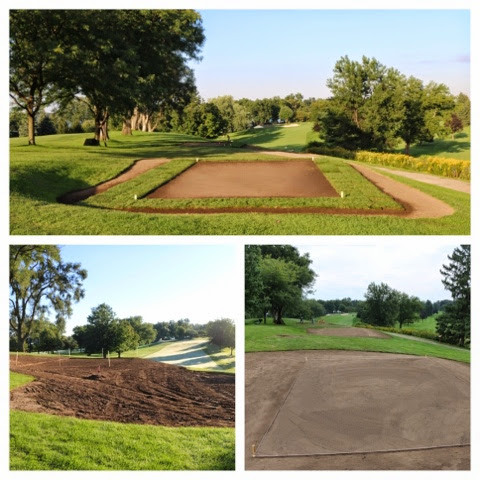
Tee Renovation Project Complete

Tee box renovation project is now completed and we have beautiful new bentgrass starting to grow on all of the tee surfaces. The weather has been absolutely fantastic for the completion of the project and we even had bentgrass germinating in only days benieth the white blankets. The renovation project consisted of 7 newly built tees (#1 Forward, #8 Forward, #9 Senior, #10 Forward, #12 Forward, #17 Forward, #18 Senior) and expansion/leveling of 14 existing tee boxes (#2 Forward, #3 Back, #7 Forward, #8 Back, #9 Back, #9 Middle, #9 Forward, #11 Forward, #12 Back, #14 Back, #16 Forward, #18 Back, #18 Middle, #18 Forward). The construction contractor; Great Lakes Golf & Site Development inc. was mobilized on site for 20 days and completed all the tee work In a mere 13 working days. Rain and wet conditions delayed or haulted work on 7 of the days, mostly during the beginning to the middle of the project. We are very happy with the results of this project and wonderful cooperation with project staff and golf course architect throughout the whole renovation.

Please remember that even though the newly seeded bentgrass tees may appier to be green and ready to open, they are very young, tender and unable to sustain golfer traffic. The newly constructed tees need the remainder of this fall to fully fill in and mature to a healthy level. They are scheduled to open by Memorial Day. 

Please be respectful and give them the required time to complete their establishment process. Keeping your carts away from the new tees, and out of the newly sodded areas surrounding them, will make a tremendous difference. Your help and cooperation is much appreciated by the grounds staff and golfing membership.

Sunday, September 21, 2014

Fairway/Approach Fall Aerification

Aerification is commonly one of the taboo words related to golf and a golfers expectations on course conditions. With the great leaps and bounds in golf course equipment technology over the past 10 years we are able to perform these operations more efficiently and with less disruption to the surface... Ultimately resulting in better course conditions immediately following core cultivation and little or no impact on your round of golf.

Goal- 
A healthy stand of grass naturally recycles organic matter into the upper soil profile of the fairways/approaches when roots, shoots, stolons, and other plant parts are replaced throughout the season. This organic matter accumulation must be removed with core aeration. When a significant layer of thatch and organic matter develops, the surface becomes "spongy", holding water and creating other issues related to plant health and disease susceptibility.

Process-
1. Fairways/Approaches are punched with 7/8" tines on 2"-3" spacing, 5" deep, removing a significant amount of material and leaving one heck of a mess on the surface.

 
2. Plugs are allowed to dry slightly on the surface before they are broken apart with a large drag, removing the soil from the organic layer.

3. Once the plugs have dried to the correct moisture level, a large drag is run in a couple different directions to break the plugs apart and seperate the thatch from the soil particles.

4. After the dragging process is finished, soil has been removed from the organic matter pieces and deposited back into the open holes leaving behind some light fluffy mayerial and most all holes filled.

5. The fairways/approaches are then blown off by a team of blowers, blowing all the grass and organic matter to the side for removal.

6. The material is then vacuumed up from the sides and moved to the compost site.

7. Final cleanup preparations are performed and debris is cleaned up in specific locations where the blowers and vaccum didn't clean to a desired level.

8. The fairways/approaches are then mowed to remove any tufts of grass sticking up from the aerification process and cleaning the surface for play.

Finished Product-
The aerification process really does leave behind very minimal disruption to the playing surface but creates so many key benefits to plant health and maintaining proper soil structure. Holes will be completely healed within a week and there will be little to no detection anything ever happened.

Take Home Message & Benifits-
An important purpose of core aeration is the physical removal of unwanted organic matter from the upper portion of the rootzone. When core aeration is neglected, the upper portion of the profile can become an inhospitable place for plant roots to grow. The pore space in a dense organic layer is dominated by small, water-filled capillary pores, while the large air-filled macropores are lacking. Oxygen is necessary for the plant to cary out respiration, which is the conversion of stored food to energy. Respiration takes place in the roots and, therefore, good air exchange in the upper soil profile is vital to plant survival. 

Aerification of Turfgrass is a necessary evil (cultural practice) to maintain healthy plants. Benefits are Thatch Control, Compaction Relief, Beneficial Air and Gas Exchange to the root zone, Improved water movement, Greater nutrient penetration, Increased shoot and root growth, Improved soil structure... All vital to a healthy stand of grass. The medicine (Aerification) does not always taste good, but a healthy patient (Grass) is worth the effort and inconvenience. It is always our goal to make aerification as painless as possible.

 Short Videos Showing the Fairway Aerifyer In Action
 

Saturday, September 20, 2014

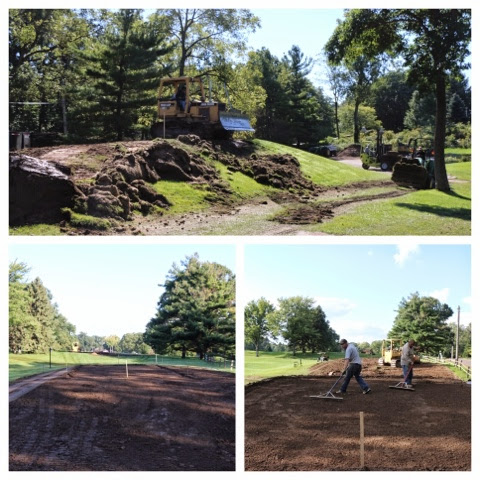
Tee Project - Week 2 Update

 
The tee box renovation project is progressing along better than expected on this second week and we can see the light at the end of the tunnel now, with construction nearing the final few tee box locations. Weather has been fantastic this past week and the crew made huge progress with the dry and cool temperatures. We now have 14 tee boxes completed and seeded with only 7 left to complete. The construction crew is doing a fantastic job on all the many details related to the scope of the project and leaving behind virtually no damage to the course.

#3 Back Tee

#2 Forward Tee

#1 Forward Tee

#10 Forward Tee

#8 Forward Tee

#8 Back Tee

#17 Forward Tee

#18 Back, Middle, Senior (New), Forward

#16 Forward Tee

Wednesday, September 10, 2014

Tee Project - Week 1 Update

With a very productive first week of construction in the books, things are really starting to take shape on the first 10 tee boxes of the tee renovation project. The weather has created several challenges already, haulting work on two days and delaying work on two others with heavy rainfall and wet conditions. The construction crew is doing a fantastic job and making huge progress, working sun up to sun down 7 days a week and leaving behind very minimal disruption to the golf course.

#7 Forward Tee

#12 Forward Tee (New)

#14 Back Tee

#9 Back, Middle, Senior (New), Forward Tees
#11 Forward Tee

Construction Equipment Arrives On Site

Tree Removal At #9 Back & Middle Tees

Tree Removal At #18 Back & Middle Tees

Sunday, August 31, 2014

Proper Driving Range Divot Patterns

When practicing from the driving range tee, it is important to remember the proper divot patterns that are recommended. Spreading divots around or taking divots in strips with undisterbed turf between, is the preferred method we ask that you use. 

Leaving small areas of turf between divots, will provide a much faster recovery time to the teeing area. When a large hole of concentrated divots is created, this requires a much longer recovery time with no remaining turfgrass plants within the area, to aid in recovery from the inside out. This situation requires the damaged area to only recover from the grass seed/sand that's applied by the grounds staff, while the single divots or strips are immediately filling in from the sides and healed much faster. 

Large hole divots suffer from erosion and heavy rainfall, washing the seed/sand out with no remaining turf to stabilize area or help it re-establish. Mowing equipment will also essentially push or scoop sand from the large holes as the cutting units pass over the uneven surface, ultimately delaying recovery of that particular teeing location.

We appreciate your help when it comes to the health of the practice area turf and keeping the driving range tee/shortgame area in good condition. Continuing to educate members and your peers on the proper divot taking methods will keep the turf recovering consistantly throughout the golfing season, always providing a quality surface to practice from.